
Rugby league finds itself in a state of flux. But it doesn’t have to be that way.
How did we get here?
In the modern era, the second and third tier has traditionally been made up of semi-professional clubs. There generally used to be a handful of full-time clubs, often those that had been relegated from Super League looking to bounce back up (like Huddersfield, Castleford, Widnes) and others who had ambitions of being in Super League long term (like Hull KR, Leigh).
In the 2000s, the salary cap was at a level whereby the ambitious clubs could run full-time but not to a level where the part-time clubs would be blown away. Clearly, the state of the game and the level of players has changed significantly since those days, and there is now a clear gulf between full-time and part-time players due to the nature of the game, advances in sport science, fitness, nutrition etc.
That realistic salary cap was blown apart in the mid-2010s due to the Super 8s concept, but also because overseas teams like Toulouse and Toronto naturally couldn’t put teams together on that budget. This has had a long-lasting effect of driving up player salaries in the second and third tier to unrealistic and unsustainable levels, given the revenue these clubs are generating.
The good news there has at least been steps this year to address, and a more realistic salary cap is being introduced for 2027.
The format under Super League
Before 2026, the last time we had just one professional league under Super League was 2002 – the Northern Ford Premiership. This consisted of 19 teams, before York went bust after 11 games and their results were expunged from the records. Everybody played everybody else at least one, with some teams having 13 home games and some having 14. There was a top nine play-off.
For 2003, National League 1 and National League 2 was introduced. I previously wrote on Love Rugby League how the format from 2004 for semi-pro rugby league and rugby league as a whole appeared to actually be the peak of recent years.
Here is a graph showing the number of teams across all three divisions over the past 25 years.
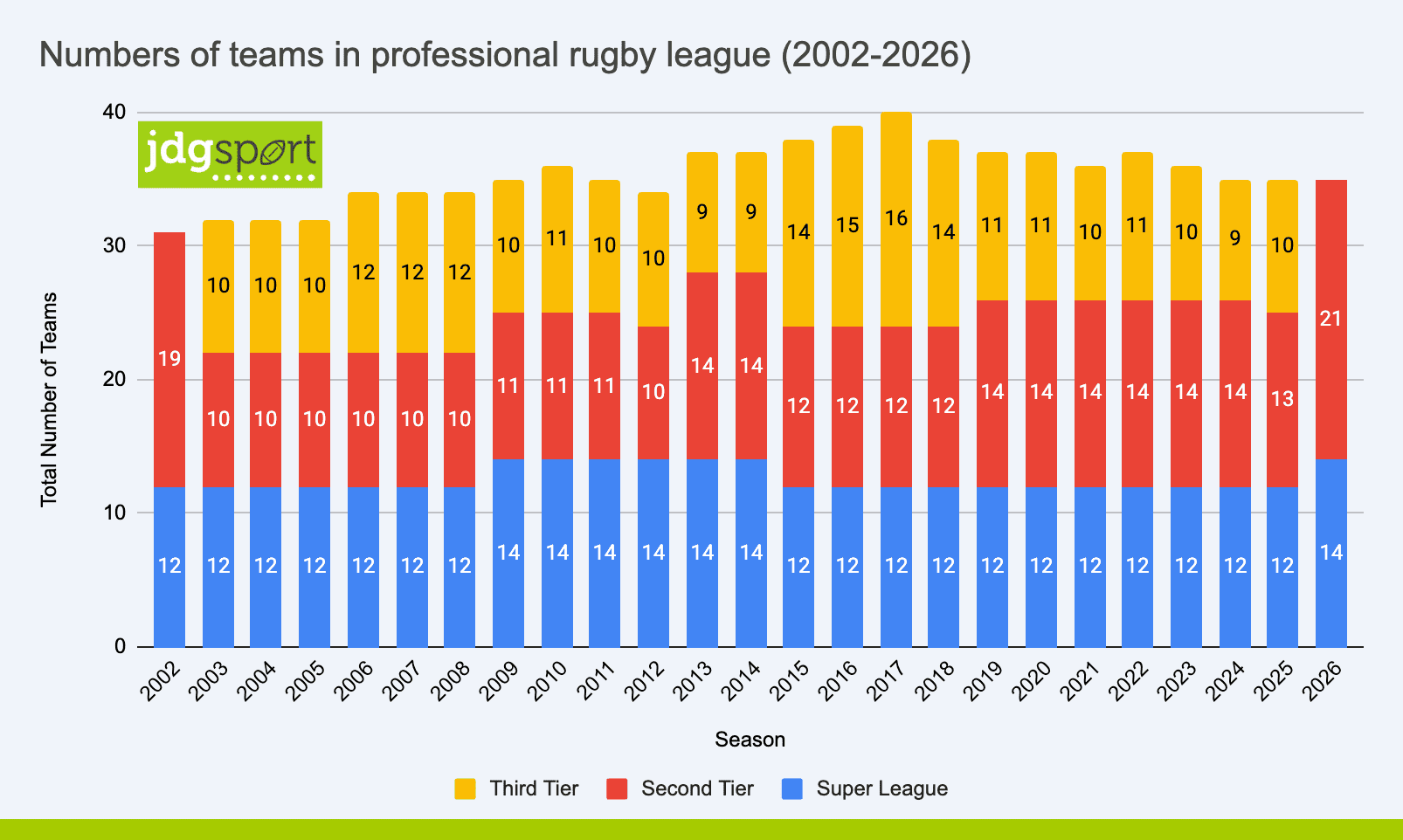
Although there were some variations of competition number of those years, they run as separate competitions, home and away format and promotion and relegation between them. The introduction of the Super 8s concept for 2015 didn’t alter that too drastically, it just meant that rather than having the standard play-offs, the top four in the renamed Championship played against the bottom four of Super League to try and earn promotion. The remaining eight Championship teams then played against each other for an extra game apiece.
Where things started to turn was post-COVID. The strategy of expanding the semi-professional game had backtracked with some clubs withdrawing. The Championship had by now increased to 14 teams, but that meant League One suffered from the withdrawals and ran with nine teams in 2025 – clearly not sustainable.
The problem was that while years before when both leagues had as little as 10 teams each, they could play 18 league games and have fixtures supplemented by a league cup competition (the old Northern Rail Cup used to have a round robin format guaranteeing clubs an extra three home games each per season), the Championship clubs didn’t need this any more as they already had 13 home games guaranteed from their league format, whereas the League One clubs were left squandered on a meagre eight.
The plan initially was to go to two leagues of 12 – hence the introduction of Goole Vikings to League One and the reduction of the Championship to 13 teams ahead of 2025 – and then have a Super 8s format between Championship and League One. But that was kiboshed by Super League’s increase to 14 teams and the collapse of Cornwall, perhaps highlighting what I said earlier about needing to come up with a format that isn’t reliant on what happens in Super League.
ALSO READ: 40 years of pins in the professional rugby league map
Making decisions independent of Super League
The format of the Championship cannot be dependent on the make up of Super League. It needs to come up with a format that works stand alone. Sure, there needs to be a mechanism for clubs to move between Super League and the Championship (whether that be via licensing, promotion and relegation or otherwise) but the current annual ‘let’s wait and see what happens with Super League’ is killing everyone.
Over the past few decades, clubs have become complacent due to central funding. As a result, it’s felt that the number of teams has been driven by how many pieces clubs want the pie to be sliced in to.
Some semi-pro clubs have simply existed off the back of that central funding via the Super League TV deal. While that was seemingly accepted when the TV deal was good, when it has been trimmed in recent years, Super League clubs are understandably more reluctant to share their ever-decreasing funds.
The semi-pro clubs have to operate as if there is no central funding now. Sure, some may filter down in prize money or similar, and it may result in some clubs not being able to continue. Hopefully that won’t be the case.
But you also need to provide the carrot of possible Super League to the Championship clubs, to create hope and something to strive for. The current system kills that. A team doing well would typically attract more fans, but as soon as you’re told ‘there’s no chance of promotion’ people lose interest. If a team earns promotion but doesn’t meet minimum standards, well then that’s fine. That’s what they then need to strive for. One of the reasons the football pyramid is so successful is because every team can dream of reaching the top – no matter how unlikely that might be.
Why the 2026 format hasn’t worked
The 2026 Championship season has largely been a disaster. One of the competition’s biggest clubs, Featherstone, disappearing on the eve of the season. The uncertainty around Salford following their demotion from Super League. Losing the three strongest clubs of last season to Super League. And then the problems faced by Halifax and North Wales Crusaders during the campaign are enough.
But they were increased by the ridiculous fixture format, that saw every team play 12 other teams home and away based on a formula governed by last season’s league positions. Featherstone disappearing after the fixtures were drawn meant that some clubs were left playing two fewer games than others, which meant more pairs of fixtures had to be shoehorned in.
There is too big of a disparity between the top clubs and the bottom ones – and currently, the only way that’s realistically going to be resolved is by dragging the top clubs down to a lower level, which is surely counter-productive for the sport.
This all came about by the decision towards the end of last season to merge the Championship and League One – something that had previously been voted against a few years ago.
Rochdale, for example, are a responsibly run club that were in League One. They were naturally supportive of the merged competitions, because why wouldn’t they be? However, I’m sure one of the more motivating factors for that view was that they would then get to play some of the bigger Championship teams. But despite that, the fixture list didn’t pit them against either Widnes or Halifax, two clubs within reasonable distance of them.
London, who recruited on the basis they would be in Super League in 2027 and likely would have been had Toulouse not beat York in last season’s Grand Final, have blown everyone (except Oldham) away; while also reaching the 1895 Cup final, which has descended in to farce due to the fact it was scheduled on the same weekend as a full round of fixtures, forcing Widnes to sign 11 players to fulfil their final league game merely four days before it.
The good news is, it seems the clubs agree that the 2026 format cannot continue.
What is the best future proof format for semi-professional rugby league?
In my view, there are three options:
- Regional conferences with play-off system at end of season
- Two division set-up with promotion/relegation and a round-robin cup competition
- Two division set-up that includes Super League reserve teams
Regional split
The regional conferences idea was mooted ahead of the 2026 season, but wasn’t agreed upon. There are probably enough Yorkshire teams to create their own conference – however, that then means the likes of Featherstone and Halifax would lose games against Widnes and Oldham, for example.
The non-Yorkshire conference would also be made up of a much wider geographical area, with the Cumbrian teams and outlier teams like North Wales (or Wales) and Midlands.
It would provide a more flexible format in terms of number of teams, and then you would have a cross-play-off competition at the end between the two conferences.
Back to two divisions
Returning to Championship and League One (though my preference would be a name change to both!) would need to happen with a smaller second tier division. It could run with 20 teams, as demonstrated previously. So two leagues of 10, with two up, two down between.
To make up the fixtures, the old Northern Rail Cup format could be re-introduced on a geographical basis. So Widnes and Oldham, for example, would be in a cup group with Swinton and Rochdale. Teams then get their nine home league games (or more if more teams are found), plus three guaranteed cup games.
Add Super League reserves
My personal favourite suggestion at the moment is to introduce Super League reserve sides to the semi-professional tiers, similar to how ‘B’ teams feature in Spanish football. These sides would be able to reach the Championship but obviously not earn promotion to Super League. They wouldn’t feature in cup competitions either.
Imagine a Wigan Reserves side playing at Robin Park every other Sunday, or Warrington at Victoria Park. The presence of Super League-funded teams would then mean adding development teams across the country becomes more feasible. Clearly, one of the battles from previous in League One is the sheer cost of those teams travelling to Wales, London, Newcastle etc.
It would reduce pressure on the number of teams – if say seven Super League clubs decided to follow this stand-alone model, you’d have 28 teams to split across the two leagues. That may be too ambitious or too many for now, but of course there’s no guarantee that some of the current 21 non-SL teams will still be in the semi-pro tiers next season for different reasons – thinking London, Featherstone, North Wales. Some Super League clubs may choose to do what York and Newcastle have done this year instead, or as we expect Huddersfield and Dewsbury to do next season.
Based on current league positions (which clearly wouldn’t necessarily be the fairest way to decide right now), and assuming London go to Super League, if you added four reserve sides the competitions could look like:
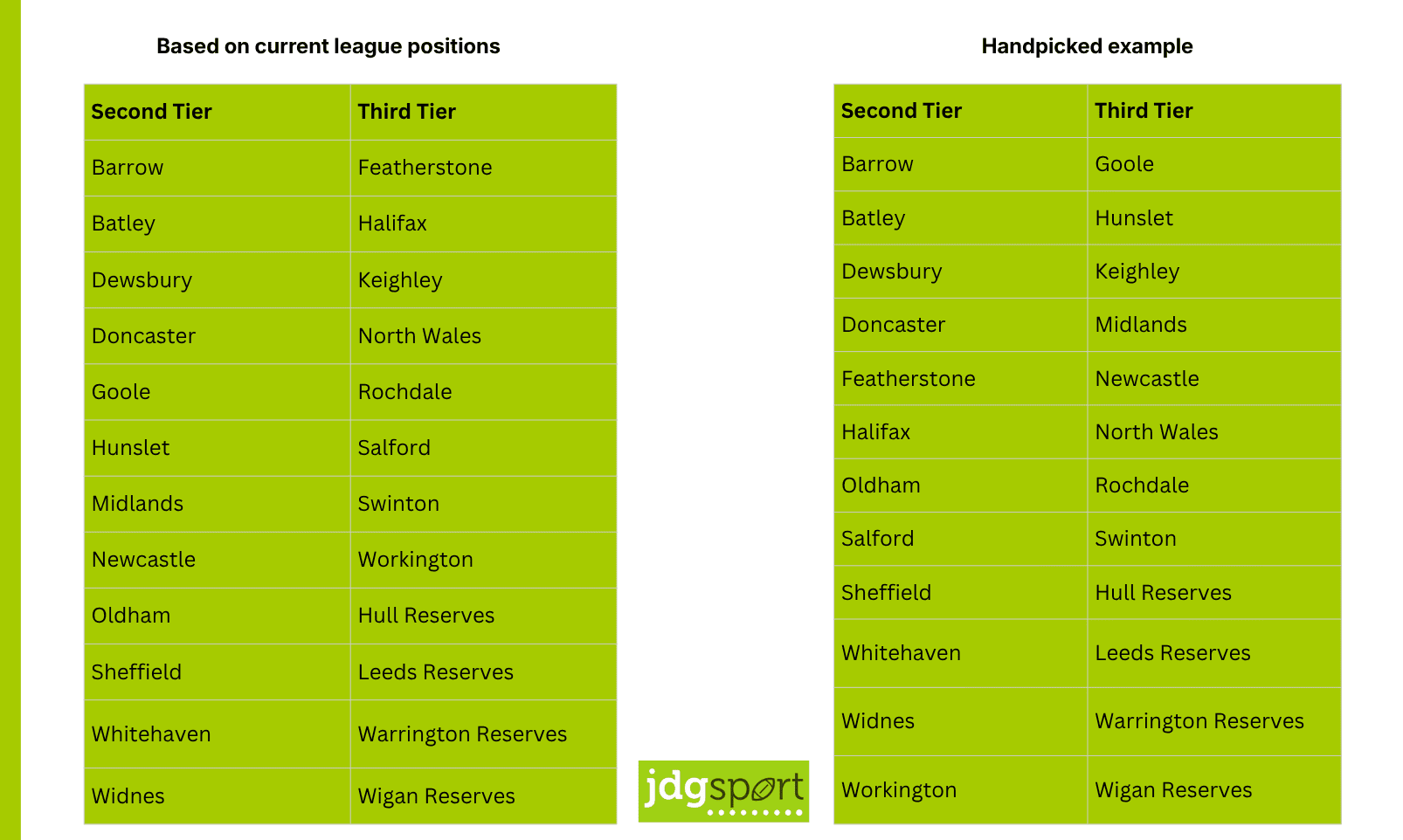
There are possible challenges over the player pool – but ultimately at the moment, the Super League clubs with academies are sitting on hundreds of players from scholarship through to academy levels; where are these players going when they drop out of those systems?
Creating a reset and refresh for semi-professional rugby league
Grouping Super League with the Championship and League One as ‘professional rugby league’ leads to damaging ‘there’s too many clubs’ claims. There isn’t. Super League should be acknowledged as the elite, full-time game. Underneath should be regarded as semi-professional, akin to how non-league football is viewed against the Football League.
With that separation, Championship rugby league can focus on its own strengths and taking inspiration from the growth of non-league football. But to do that, it needs to reset in some areas and improve vastly in others.
Rugby league seems to have lost itself in that being in Super League is the be all and end all, when the Championship can be a thriving part-time competition that ought to be worth winning in its own right.
Such is the gulf between full time and part time now, it is hard to see how the gap can ever be bridged. Therefore, I am of the belief that making the best of the Championship is important, to ensure rugby league participation continues and to ensure grassroots still have a feasible aspiration for growth.
There will still be clubs that use the Championship as a stepping stone to Super League, which makes it all the more important to raise the profile of the Championship.
Data: Vastly improve the match and player data available. Data is embarrassingly sparse, and only dedicated resources such as Rugby League Project and Rugby League Record Keepers’ Club provide online. As well as team line-ups and scorers, data such as offloads, tackles and penalties should in this day and age be tracked and publicised – clubs are doing this themselves through analysis anyway. Making this data available then attracts greater interest in players. The game should be proactive in then providing live data to third parties (for example, Flash Score only has full time results only). When you compare to other sports, the lack of data is embarrassing.
For example, look at this from a match in the British Championship Basketball League or this from the second tier of British Ice Hockey. Compare to rugby league, where only the try scorers and line-ups are known!
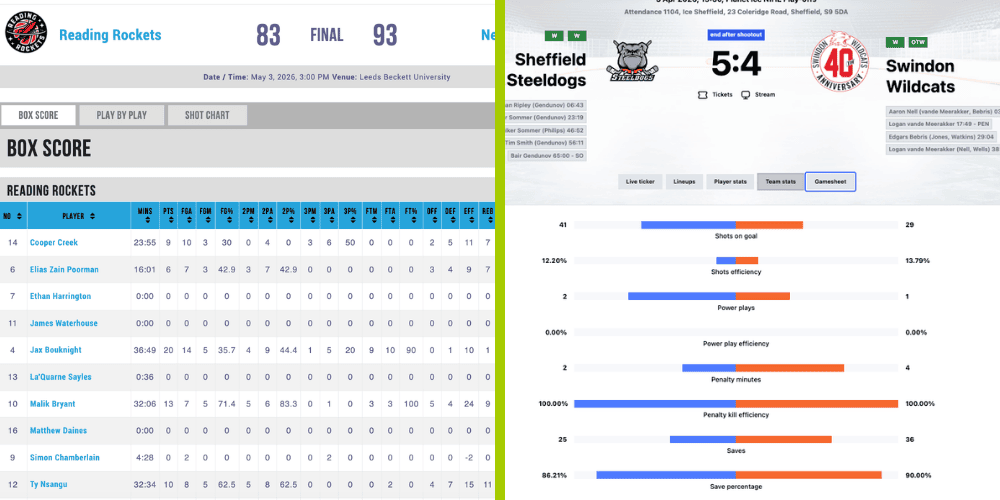
Example match data from the second tier of British basketball and ice hockey
Centralised support: Assist clubs by creating centralised systems or consultant to improve standards and professionalism, in areas like website, social media, ticketing, retail and branding.
Curate: bring together and support the content being created by clubs themselves, sometimes by dedicated volunteers.
Make video accessible: pull together more highlights and try shows to give more eyeballs on the Championship, even in the absence of a TV deal.
Ticket prices: some clubs are charging up to £25 now for games. This is far too much for semi-pro rugby, especially when compared to the competing market of non-league football. Those prices are partly driven by the growth in wages for part-time players caused by other factors. The revised salary cap may help create a reset in this area.
There are rugby league first facilities at: Barrow, Batley, Dewsbury, Keighley, Whitehaven, Widnes, Workington; then Doncaster, Halifax, Oldham, Rochdale and Salford all have well-appointed and established relationships at their shared grounds. Goole and Swinton have solid bases. Midlands are ambitious. Sheffield are fighting for their own home. North Wales at Colwyn Bay is great, but they’re also now trying to explore further opportunities. The foundations are there for a solid, long-term semi-professional competition.
Rugby union has recently rebranded its second tier to Champ Rugby, enabling it to operate commercially in its own right and grow. There are minimum standards, stand-alone branding and coverage, and centralised support. They too seek to maintain some sort of promotion and relegation to the top tier.
Other ideas
Last year, I produced a paper for a possible dedicated Championship Rugby League brand that would focus on providing news, information, data and video for the semi-professional game.
Another current fault of the game is that the clubs are discouraged from engaging externally. With clubs needing to hit certain parameters for their own social media and website channels, it then means they are reluctant or demotivated to reach out to local and national media, TV companies and even fan channels to produce and share their content.
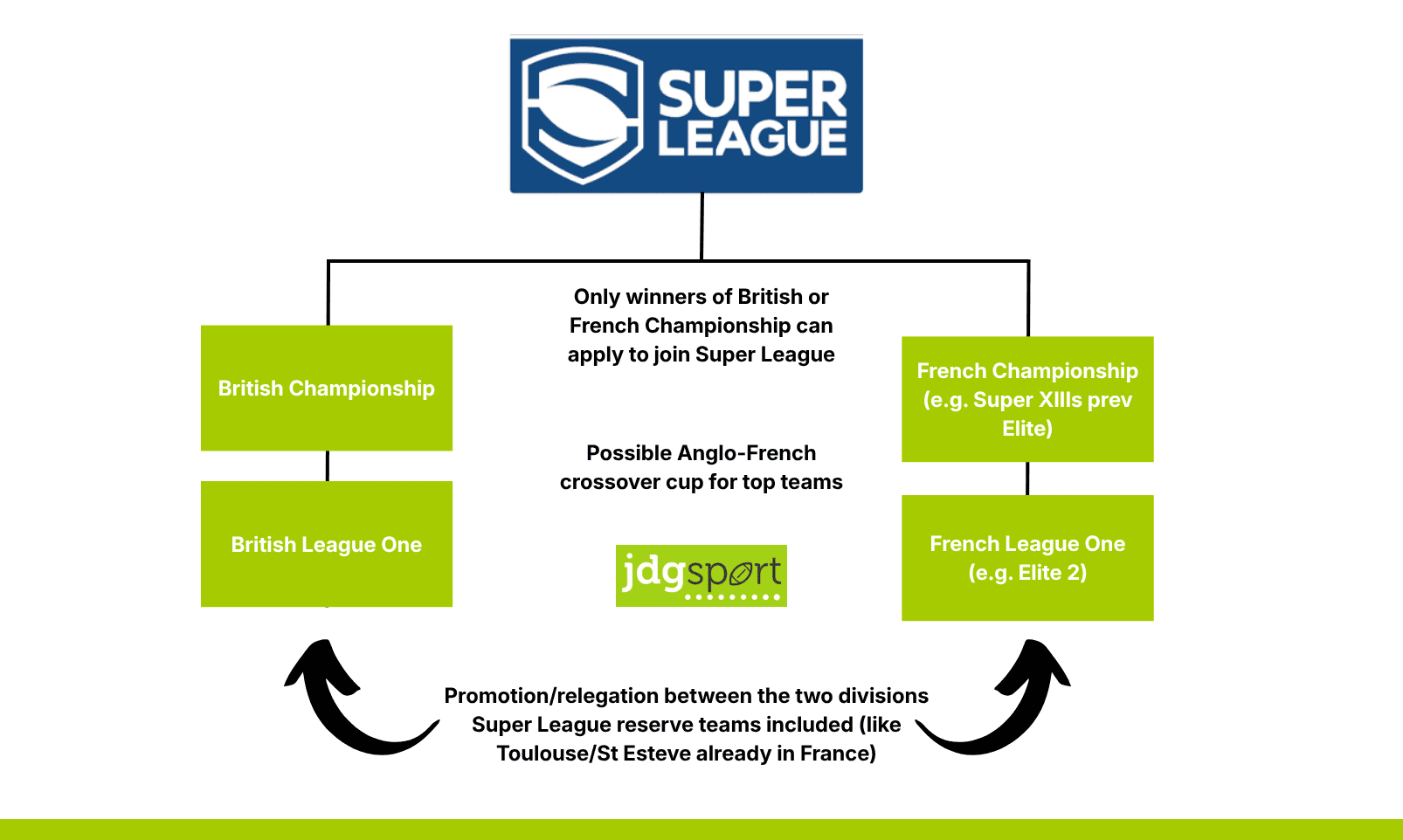
UK and France side-by-side: Embrace Super League as the ‘European’ competition by re-inventing the British Rugby League Championship to sit alongside the French Elite Championship as the top domestic competitions. The site would also cover French Championship, to encourage growth and exposure of both competitions.
Second-tier heritage: Create historical context to the division by listing all previous ‘second tier’ winners, rather than it seemingly only now going back to 2002. So for instance, this year would be London’s third triumph – after 1983 and 2023.
Re-brand: Made slightly awkward by France’s recent change to Super XIIIs. Is that a name that could work in the UK too, and provide a clear differentiator from rugby union?
Play to strengths: Try to create the same buzz and boom that non-league football is experiencing by championing and being realistic about rugby league, and providing the context around it. Yes, Super League and the elite level needs to chase commercial growth, more revenue and TV attention, but the Championship can be real, about rugby and sustainable wherever it is played.
Scrap play-offs: Make the ‘league leaders’ the (part-time / semi-pro) British Rugby League Champions (ie. scrap Grand Final concept)
Top eight cup comp: Operate the top eight as a start from scratch, separate end of season competition (like an extended Premiership concept) if no suitable league cup format can be created.
Euro clash: Play an annual European Championship match between the British Championship and French Championship champions in January/February ahead of the new British season; possibly expanding this over time to involve more teams
Whatever happens, the in-fighting needs to stop. Rugby league has consumed itself in recent years and has become increasingly anonymous not only to the wider sporting public, but the public of its own communities. That needs to change.
What do you think? Have you got any ideas? Let me know in the comments below.
About James Gordon: Passionate about sport, my entire career has been spent working around professional sport, starting with my first job out of university running the official Carling Cup website and Carling’s football sponsorship activations. I previously founded and operated Love Rugby League as managing editor from 2005 to 2023. I commentate on games every week in Super League and Championship for BBC local radio, have reported on a freelance basis for many years, as well as operating JDG Media, providing media and consultancy services to clubs, leagues and brands. Over the years I have worked with professional basketball and ice hockey clubs in the UK, semi-professional rugby league clubs and continue to work extensively in semi-professional football. That includes working directly with England Ice Hockey, Basketball England and the Northern Premier League and Isthmian Football Leagues.





James Parle
August 28, 2026 at 4:45 pm
The RFL’s appetite for SL expansion and changing the format too often killed the game imo. It became difficult to follow what was going on and made no financial sense to drag part time players across to Toronto for example.
I think expansion has been the main cause of why the game is in that state it is. The RFL seems to cringe at the thought that RL in the UK sits around the M62 corridor instead of owning that fact and putting it on a pedestal- “it’s our game, not yours” – it’s the origin of the sport after all. It’s basic human psychology that humans want something they can’t have, focus on the “heartlands” of the game and build it’s reputation back up with a swagger and it will naturally gain interest elsewhere – instead of trying to force it down the throats of cities and regions that don’t care and moving or renaming the team every other year so it has no solid foundation.
Aside from that, I’ve always hoped RL could get towards something similar in terms of a “European” competition that football has, but until we create an attractive product we’re miles away from that prospect. I’m of the opinion that domestic leagues should be for domestic teams, I’d like to think sending Catalans and Toulouse back to the French structure would help develop the sport there then we could have at least two solid structures in the Northern hemisphere but sadly there’s likely more of a risk that it does the opposite.